Almost everything written about getting into investment banking assumes you are twenty years old, at a target school, and have a free summer to spend on an unpaid internship.
That advice is useless if you are thirty-one, earning $95,000, and have a mortgage.
The route in for an experienced professional is a genuinely different process. Not harder in every respect, but different in ways that matter. If you run the undergraduate playbook from a mid-career seat, you will spend eight months applying and hear almost nothing back.
Here is what the process actually looks like.
Start from the honest version of the math
The uncomfortable part first. A single analyst or associate posting at a recognised bank routinely draws several hundred applications, and a large share of them are filtered before a human reads a word. That filtering is not a judgement on your ability. It is a volume problem being solved by software.
Which means the first question is not "am I good enough". It is "will anyone see this at all".
Two things follow from that, and they set up everything else.
One application is not a data point. Candidates tell us they applied to fifteen roles and nothing happened, and conclude the market is closed. Fifteen is not a sample. Given realistic response rates on cold applications, fifteen submissions is statistically indistinguishable from zero.
Your competition is not other career changers. It is candidates who never touch the portal at all, because someone inside the firm passed their CV to a hiring manager directly.
The three reasons experienced candidates get filtered out
Your CV is written for the job you have
Most professionals write a CV that describes their responsibilities. Banking screens for evidence of transferable, quantifiable work: deal exposure, financial modelling, valuation, diligence, client-facing commercial judgement.
A senior operations manager who has run a $40m budget, built the model behind a pricing decision, and sat in on an acquisition has a genuinely relevant profile. Most of them describe it as "managed cross-functional stakeholders". That version does not survive a screen.
You are applying into a calendar you cannot see
Banking hiring runs on cycles, and off-cycle processes move quickly and quietly. By the time a role is publicly posted, the shortlist is often already forming from internal referrals and headhunter pipelines. Applying on day forty of a public posting is not the same opportunity as being in front of that team on day one.
Your CV is one document
You submit the same PDF to a private equity role, a coverage role and a restructuring role. Each of those reads for a different profile. One document optimised for none of them will underperform three documents optimised for each.
We call the fix resume mutation. Same candidate, same truthful history, three materially different documents.
What the actual path looks like
There is no clever shortcut. There is a sequence that works, and most people do it in the wrong order.
Fix the document before you spend the applications. Every application sent with a weak CV is an opportunity you cannot resubmit. Firms remember. Get the document right, then spend.
Build the evidence, not the claim. If you have never built a model, saying you are a fast learner will not carry you. Build three. Value a company you actually understand. Being able to talk through your own work is worth more than any certificate.
Go around the portal wherever possible. The highest-yield activity for an experienced candidate is direct contact with people who can refer you internally. Not a connection request. A specific, short, informed message that shows you understand what their group does.
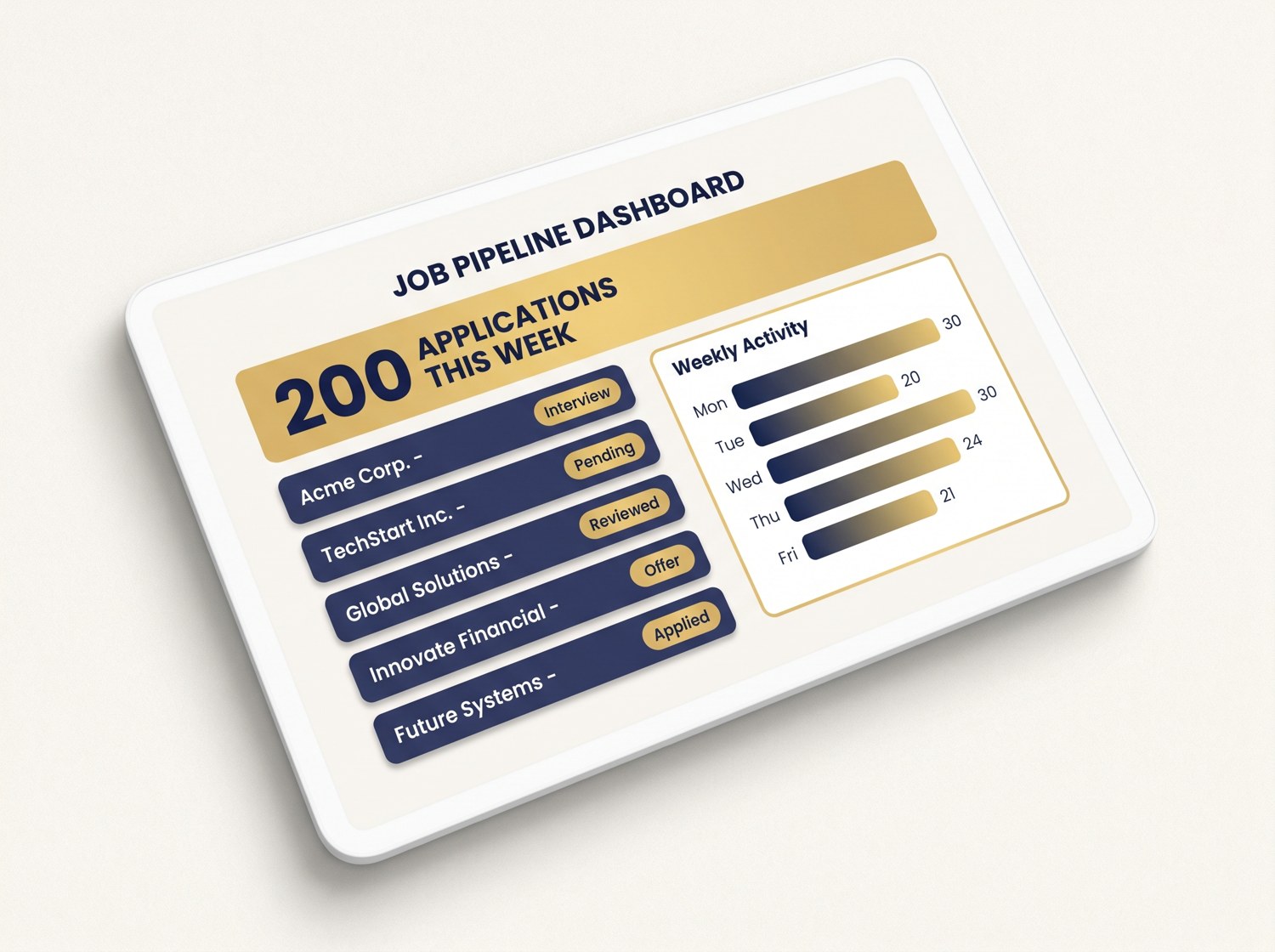
Run volume that is statistically meaningful. This is the part almost nobody does properly, because doing it manually while holding down a full-time job is close to impossible. It is why we built a dedicated application desk rather than a course.
Prepare for the interview before you have one. Technicals are learnable and largely predictable. Being caught unprepared on a walk-me-through-a-DCF question after months of work is an avoidable way to lose.
How long it really takes
For an employed professional running a serious process, plan in months rather than weeks. Our own client average sits at roughly twelve weeks from starting the search to landing an offer, and that is with a full team running the volume, the outreach and the scheduling.
Doing it alone alongside a demanding job, six to nine months is a more realistic expectation. That is not discouraging, it is planning. The people who fail are usually the ones who expected six weeks and stopped at week seven.
What about the pay cut
It is a fair question and it deserves a straight answer.
Some experienced hires do take a short-term step back on total compensation to move into banking, particularly when moving across from a completely unrelated function. Others move sideways on base and forward significantly on bonus and trajectory.
The right way to evaluate it is not year one. It is where the two paths sit at year five. Staying in a role you have outgrown carries its own cost, and it compounds quietly. We call it the Loyalty Tax, and it is the single most expensive thing most professionals never put a number on.
Across the people we have worked with, placements have landed in a $150,000 to $400,000 range, into firms including Evercore, Citi, Goldman Sachs, Morgan Stanley, Jefferies and Blackstone.
The short version
Getting into investment banking from an existing career is not a talent problem. It is an access and volume problem wearing a talent problem's clothes.
Fix the document. Build real evidence. Go around the portal. Run genuine volume. Prepare before you need to.
If you would rather not run that machine yourself while holding down a full-time job, that is precisely the thing we do for people.